
Understanding PFAS in Florida Tap Water: Risks and Solutions
Learn about PFAS contamination in Florida's drinking water, the health impacts of 'forever chemicals,' and how to effectively filter your home tap water.
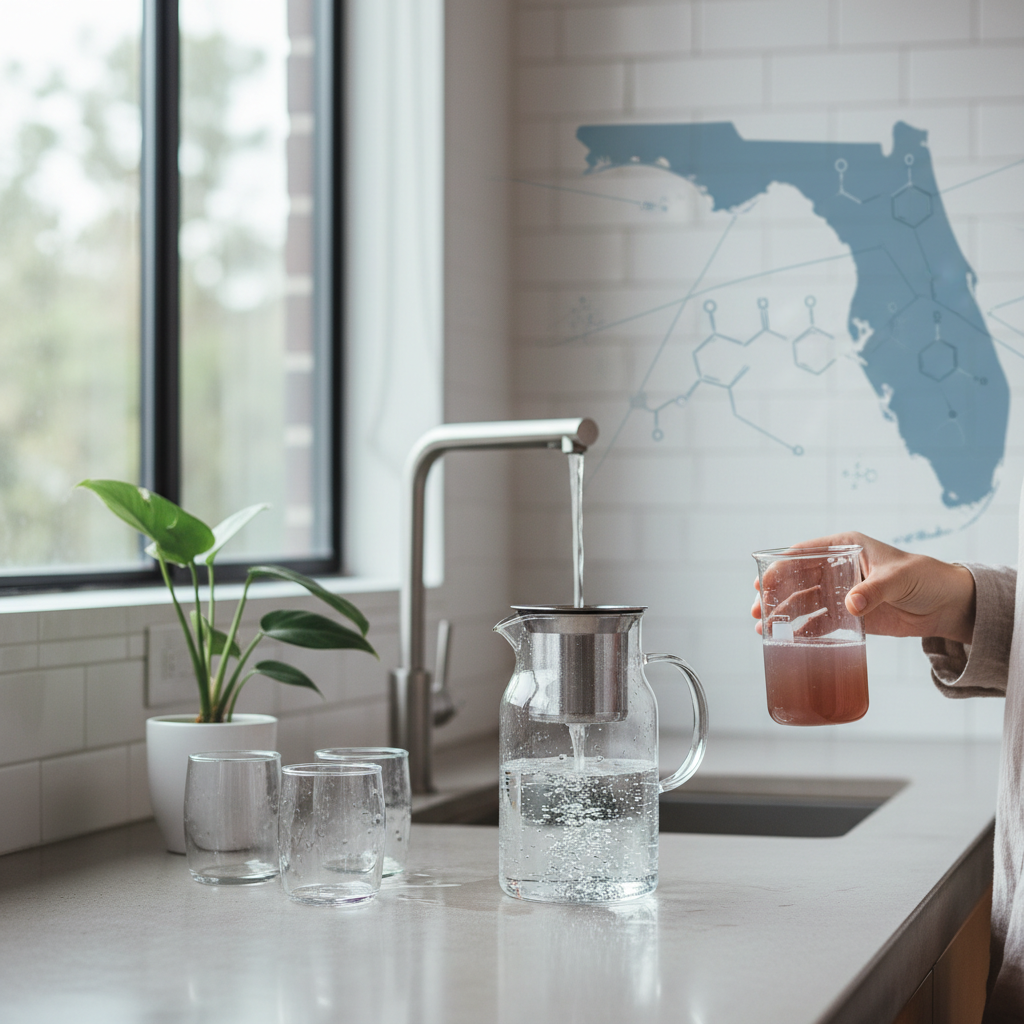
The Presence of PFAS in Florida's Water Supply
Per- and polyfluoroalkyl substances, commonly known as PFAS, represent a broad category of over 12,000 synthetic chemicals utilized in industrial processes and consumer products since the 1940s. In Florida, the presence of these 'forever chemicals' in tap water has become a subject of significant scrutiny by environmental scientists and public health officials. Their primary characteristic is an exceptionally strong carbon-fluorine bond, which prevents them from breaking down in the environment or the human body.
According to data from the Environmental Working Group (EWG) and the Florida Department of Environmental Protection (FDEP), numerous sites across the state have tested positive for PFAS concentrations that exceed the Environmental Protection Agency's (EPA) latest health advisory levels. These chemicals frequently enter Florida's unique limestone aquifer system through industrial runoff, the use of aqueous film-forming foams (AFFF) at military bases and airports, and leaching from landfills.
How PFAS Enters Florida Ecosystems
Florida's hydrology makes its groundwater particularly susceptible to contamination. The state relies heavily on the Floridan Aquifer, one of the most productive aquifers in the world. However, because the limestone structure is porous, surface contaminants can migrate into the drinking water supply with relative ease. Sources of PFAS in the region include manufacturing facilities, wastewater treatment plants that are not equipped to filter these micro-contaminants, and firefighting training areas in cities like Pensacola, Jacksonville, and Miami.
The EPA has recently introduced National Primary Drinking Water Regulations for six specific PFAS, including PFOA and PFOS. These regulations establish legally enforceable levels, known as Maximum Contaminant Levels (MCLs), at 4.0 parts per trillion. For context, one part per trillion is equivalent to a single drop of water in 20 Olympic-sized swimming pools. The stringency of these limits reflects the evolving scientific consensus on the toxicity of these compounds even at infinitesimal doses.
Health Implications of Chronic Exposure
PFAS are considered bioaccumulative, meaning they build up in the human bloodstream over time. Peer-reviewed research, including longitudinal studies cited by the Centers for Disease Control and Prevention (CDC), has linked long-term PFAS exposure to several adverse health outcomes. These include disruptions to the endocrine system, increased cholesterol levels, impacts on liver enzyme function, and decreased vaccine response in children.
Furthermore, the International Agency for Research on Cancer (IARC) has recently classified PFOA as carcinogenic to humans. In Florida, where residents may be exposed through both drinking water and local seafood consumption, understanding the cumulative load is essential for long-term wellness. Pregnant women and infants are often cited as the most vulnerable populations due to the potential for developmental delays and pregnancy-induced hypertension.
Identifying PFAS in Your Home Water
Standard municipal water reports, known as Consumer Confidence Reports (CCR), are required to disclose regulated contaminants. However, because the new EPA standards are currently in a transition period for enforcement, some local utilities may not yet provide comprehensive PFAS data in their annual summaries. Residents who rely on private wells in Florida are particularly at risk, as these wells are not regulated by the Safe Drinking Water Act.
To accurately determine the PFAS levels in your specific home, laboratory testing is necessary. Look for laboratories certified in EPA Method 533 or 537.1, which are specifically designed to detect these compounds at extremely low concentrations. DIY home test kits are generally less reliable for PFAS due to the risk of cross-contamination during the sampling process.
Effective Removal Technologies
If PFAS are detected in your water supply, standard pitcher filters or basic refrigerator filters are often insufficient for comprehensive removal. The following technologies have been verified by organizations such as NSF International and the American National Standards Institute (ANSI) for their effectiveness in reducing PFAS concentrations:
- Activated Carbon Filtration: Granular Activated Carbon (GAC) filters are highly effective at adsorbing PFAS. The chemicals adhere to the carbon surface as water passes through. This method is often used in both whole-house systems and point-of-use filters (NSF/ANSI 53 standard).
- Reverse Osmosis (RO): RO systems use a semi-permeable membrane to mechanically separate contaminants from water molecules. High-quality RO systems can remove upwards of 90% of PFAS and are typically installed under the kitchen sink for drinking and cooking water (NSF/ANSI 58 standard).
- Ion Exchange Resins: This technology uses specialized beads that act like magnets, swapping PFAS ions for harmless ions. These systems are highly efficient but are more commonly used in industrial or large-scale residential applications.
Maintenance is critical when managing PFAS. Once a filter reaches its capacity, it can no longer adsorb chemicals, and in some cases, 'breakthrough' can occur, where some of the captured contaminants are released back into the water stream. Adhering to manufacturer replacement schedules is mandatory for safety.
The Zoriah Living Perspective
At Zoriah Living, we believe that clean water is the foundational pillar of a healthy home. While the presence of PFAS in the Florida environment is a complex challenge, it is one that can be managed through informed choices and proper filtration technology. By taking a proactive approach to your water quality, you protect your household from the subtle, long-term effects of environmental toxins.
Understanding the specific composition of your tap water is the first step toward a cleaner lifestyle. If you are uncertain about the quality of your water or which filtration method is most appropriate for your home, we invite you to take the Water Health Assessment to receive a tailored overview of your needs.
The water you shower, cook and brush with touches you every day.
Unfiltered municipal water carries chlorine, chloramines, sediment, hard-water minerals and trace contaminants. A whole-home treatment system shields every tap so the water you drink, bathe in, and cook with is consistently clean.
- ●Shower & bath — protects skin and hair from chlorine dryness.
- ●Brushing teeth — removes the chemical aftertaste at every sink.
- ●Cooking & coffee — cleaner water means cleaner flavor and safer meals.
- ●Appliances — extends the life of water heater, dishwasher and washer.
Curious what's in your water?
Take the 60-second Water Health Assessment for a personalized score and recommendations.
Take the Assessment