
PFAS in Florida Tap Water: How to Protect Your Family in 2026
Learn about the risks of PFAS forever chemicals in Florida tap water and how recent funding cuts impact your water safety. Discover the best filtration methods for your home.
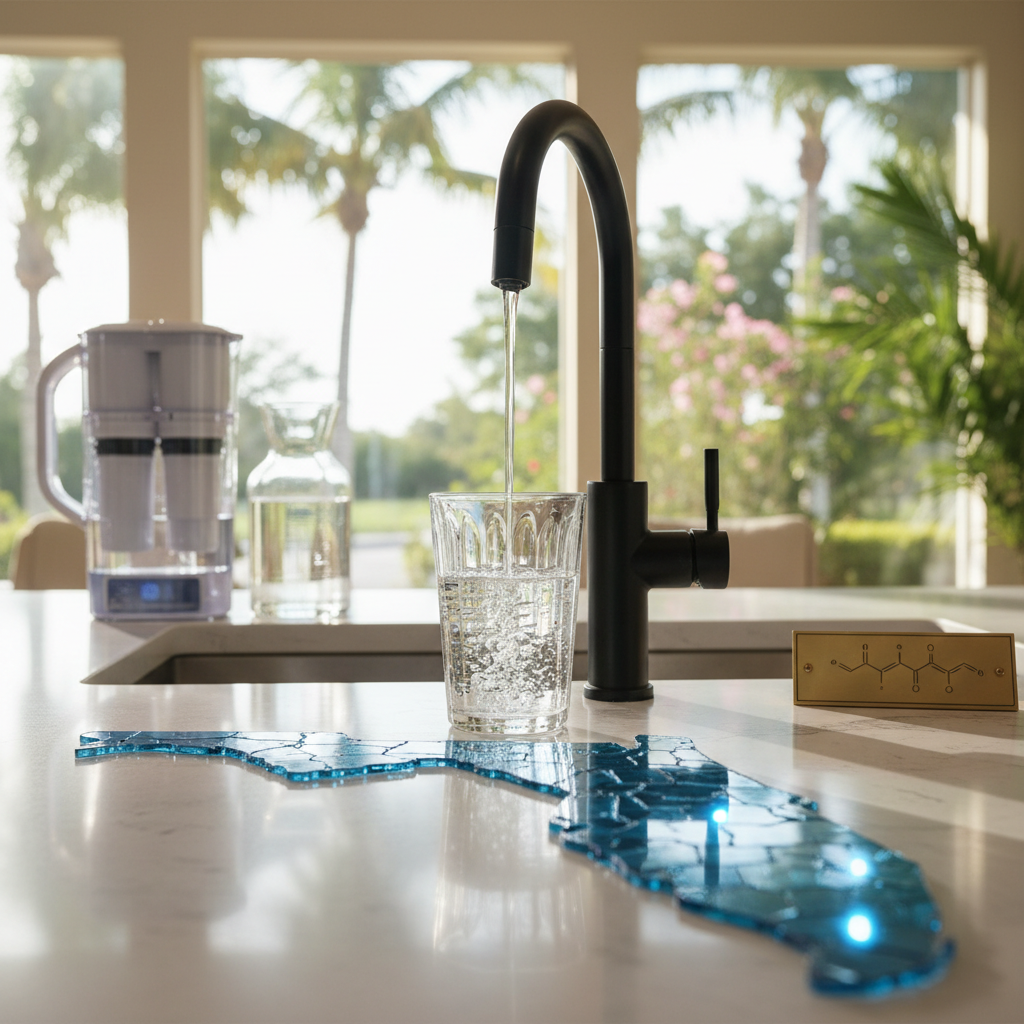
PFAS in Florida tap water has become a critical concern for homeowners as new federal regulations collide with state-level funding challenges in 2026. These per- and polyfluoroalkyl substances, often called forever chemicals, are persistent environmental contaminants linked to significant health risks, including hormonal disruption and increased cancer risk. As Florida faces unique geological vulnerabilities and shifting tax policies that impact water management districts, understanding what is in your glass has never been more vital for maintaining a healthy home.
Key takeaways
- Recent Florida property tax amendments may reduce water management funding by up to $200 million, potentially slowing PFAS remediation efforts.
- The EPA has established legally enforceable Maximum Contaminant Levels (MCLs) for six specific PFAS compounds.
- Florida’s porous limestone aquifers, such as the Biscayne and Floridan, are particularly susceptible to chemical runoff and saltwater intrusion.
- Advanced carbon filtration and reverse osmosis are the most effective ways to remove these toxins at the tap.
The Current State of Forever Chemicals in Florida
Florida is at a crossroads regarding water safety. As of July 2026, the Environmental Protection Agency (EPA) mandates that public water systems must complete initial monitoring for specific PFAS chemicals. However, the infrastructure required to filter these microscopic compounds is expensive. In Florida, the Five Water Management Districts—responsible for water quality and supply—are facing a projected $200 million budget shortfall due to recent non-school property tax exemptions. This funding gap specifically threatens the St. Johns River Water Management District and others tasked with cleaning polluted springs and ensuring the safety of the municipal supply.
For homeowners, this means local utilities may struggle to implement the high-cost granular activated carbon (GAC) or ion exchange systems necessary to meet new safety standards. If you are concerned about your local supply, you should book a water test to identify exactly what is reaching your kitchen sink.
Health Risks Associated with PFAS Exposure
PFAS are a group of over 12,000 synthetic chemicals used since the 1940s in non-stick cookware, water-repellent clothing, and firefighting foams. According to the CDC and the National Academies of Sciences, Engineering, and Medicine, long-term exposure to even low levels of PFAS in Florida tap water can lead to serious health outcomes. These include decreased fertility, developmental delays in children, and interference with the body’s natural hormones. Because these chemicals do not break down in the environment or the human body, they bioaccumulate over time.
Florida Geographies Most at Risk
Florida’s unique geology plays a major role in how contaminants move. In Southern Florida, the Biscayne Aquifer is shallow and highly permeable, making it vulnerable to surface runoff from industrial sites and airports where firefighting foams were frequently used. In Central Florida, the St. Johns River basin faces challenges from agricultural runoff and aging flood control systems that are now underfunded. Homeowners using private wells are at the highest risk, as these are not regulated by the EPA in the same way municipal systems are. Taking a free Water Health Assessment can help identify if your specific zip code or well depth puts you at higher risk.
Comparing PFAS Removal Technologies
Not all water filters are created equal. When targeting forever chemicals, standard pitcher filters often fall short. The following table compares the most common residential treatment options based on NSF/ANSI standards.
| Technology | PFAS Removal Rate | Best For |
|---|---|---|
| Reverse Osmosis (RO) | >95% | Whole-home or point-of-use purity; removes salts and heavy metals. |
| Activated Carbon | 60-90% | Removing taste, odor, and PFAS (if rated NSF 53 or 58). |
| Ion Exchange | >90% | Specific chemical targeting in high-volume systems. |
Action Plan for Florida Homeowners
Protecting your family from PFAS in Florida tap water requires a proactive approach rather than waiting for municipal upgrades that may be delayed by budget cuts. Follow these steps to secure your home’s water quality:
- Review your Consumer Confidence Report: Every annual water quality report from your utility now includes PFAS monitoring data.
- Test your source water: If you are on a private well, certified lab testing is the only way to confirm safety.
- Install certified filtration: Look for products certified to NSF/ANSI 53 or 58 standards, which specifically cover PFAS reduction.
- Maintain your system: Filters must be changed according to the manufacturer's schedule to prevent breakthrough contamination.
What to do next
The landscape of Florida water safety is changing rapidly. With the compounding issues of saltwater intrusion and reduced funding for water management districts, the responsibility for clean water is shifting toward the homeowner. To understand the specific risks in your area and determine the best filtration solution for your needs, start by taking our free Water Health Assessment. If you suspect current contamination, don't wait for symptoms to appear; book a water test with a certified laboratory professional today to ensure your family's longevity and health.
Frequently asked questions
Are PFAS regulated in Florida?
Yes, as of 2024, the EPA set federal limits for six PFAS chemicals in drinking water. Florida utilities must monitor these levels and comply with these standards, though some districts face funding challenges that may delay infrastructure improvements.
Can I boil PFAS out of my water?
No, boiling water does not remove PFAS. In fact, boiling may slightly increase the concentration of PFAS as some water evaporates while the chemicals remain behind. Only specialized filtration like reverse osmosis or activated carbon is effective.
How do I know if my Florida well has PFAS?
Private wells are not monitored by the state or local utilities. The only way to know if your well water contains PFAS is to perform a certified lab test. You can read our guides on well water maintenance for more information on testing protocols.