
Nitrate Contamination in Florida Groundwater: Protection Guide
Learn how nitrate contamination in Florida groundwater affects your home water quality and discover the best filtration methods to protect your family's long-term health.
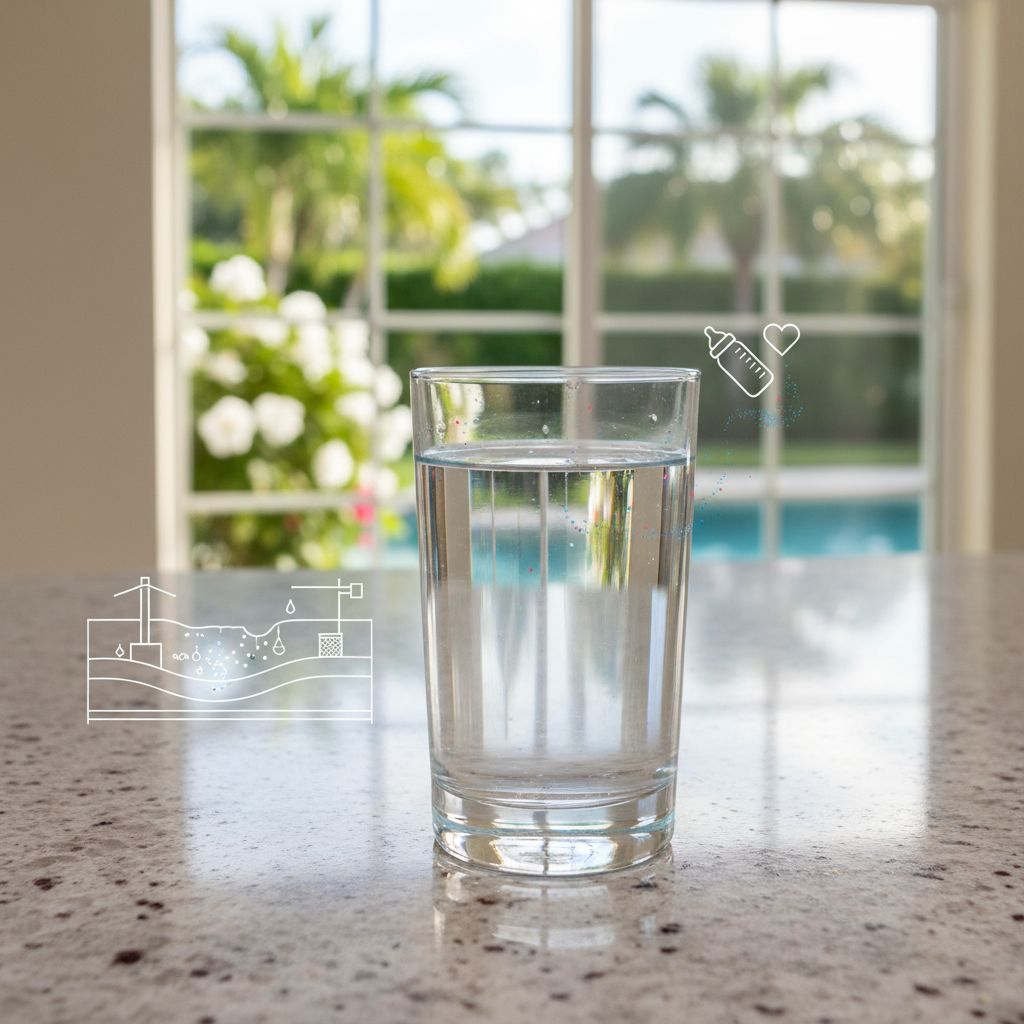
Nitrate contamination in Florida groundwater has become a critical concern for homeowners who rely on the state's vulnerable aquifer systems for their daily needs. According to the Florida Department of Environmental Protection (FDEP), high levels of nitrates often originate from fertilizer runoff, septic systems, and livestock waste, leaching through the porous limestone of the Floridan and Biscayne aquifers. Understanding these risks is essential for maintaining a healthy home, especially for those utilizing private wells or living near agricultural hubs. This guide examines the sources, health impacts, and professional solutions available to ensure your drinking water remains pure and safe.
Key takeaways
- Nitrates are colorless, odorless, and tasteless, making professional testing the only way to detect them.
- The EPA maximum contaminant level (MCL) for nitrates is 10 milligrams per liter (mg/L).
- Florida’s unique karst geology allows surface pollutants to reach groundwater rapidly.
- Reverse osmosis and ion exchange are the most effective technologies for nitrate removal.
- Vulnerable populations, including infants and pregnant women, face the highest health risks from exposure.
The sources of nitrogen in Florida's water supply
Florida’s geological structure is primarily composed of porous limestone, which creates a direct pathway from the surface to the groundwater. This phenomenon is particularly prevalent in North and Central Florida, where the Floridan Aquifer is unconfined. When nitrogen-based fertilizers are applied to residential lawns or commercial citrus groves, rain washes these chemicals into the ground. Similarly, the Florida Department of Health estimates that over 2.5 million septic systems are in use across the state. Many of these older systems are not designed to remove nitrogen, leading to steady leaching into the local water table.
Coastal regions, including Miami-Dade and Broward counties, face additional complexities. While the Biscayne Aquifer provides millions with fresh water, it is highly susceptible to saltwater intrusion and surface runoff. As urban density increases, the cumulative impact of many small-scale nitrogen sources can lead to significant nitrate contamination in Florida groundwater, affecting municipal supplies and private wells alike.
Health implications of high nitrate levels
The health risks associated with nitrates are well-documented by the Centers for Disease Control and Prevention (CDC). The most acute risk is methemoglobinemia, commonly known as Blue Baby Syndrome. This condition occurs when nitrates are converted to nitrites in the digestive system, which then interfere with the blood's ability to carry oxygen. Infants under six months of age are the most susceptible. For adults, emerging research suggests that long-term exposure to nitrates in drinking water may be linked to an increased risk of certain cancers and thyroid dysfunction, although more clinical studies are currently underway to confirm these correlations in various demographics.
The EPA has established a federal limit of 10 mg/L for nitrogen in public drinking water to prevent acute health crises, though some health advocates suggest lower levels are preferable for long-term longevity.
Detection and testing for Florida homeowners
Because you cannot see or smell nitrates, many homeowners remain unaware of the contamination until health issues arise. For those on municipal water, utility companies are required to provide annual Water Quality Reports (Consumer Confidence Reports). However, residents using private wells are responsible for their own safety. The FDEP recommends that well owners test their water at least once a year for nitrates and bacteria. If you are uncertain about your water source or haven't seen a recent report, it is prudent to book a water test to establish a baseline for your home's safety.
Nitrate removal technologies
Not all water filters are capable of removing nitrates. Standard carbon pitchers and refrigerator filters, while excellent for improving taste and removing chlorine, generally do not reduce nitrate concentrations. To effectively treat nitrate contamination in Florida groundwater, more advanced physical and chemical processes are required. The two most common methods certified by the NSF International are reverse osmosis and ion exchange.
| Technology | Mechanism | Nitrate Reduction Rate |
|---|---|---|
| Reverse Osmosis (RO) | Semi-permeable membrane | 90% - 98% |
| Ion Exchange | Specialized resin beads | 95% - 99% |
| Distillation | Evaporation and condensation | 99% |
| Activated Carbon | Adsorption | Negligible |
Reverse osmosis is often the preferred choice for residential kitchens. These systems force water through a synthetic membrane that blocks larger molecules like nitrate ions while allowing pure water molecules to pass. For whole-home protection, ion exchange systems—similar in design to water softeners but using nitrate-selective resins—can treat all the water entering the residence. This ensures that even the water used for showering or gardening is free from excessive nitrogen loads.
The role of local policy and the Florida DEP
State agencies are increasingly focused on Basin Management Action Plans (BMAPs) to address the nitrogen problem at the source. These plans target specific water bodies, such as the Santa Fe River or the springs of the St. Johns River, where nitrate levels have historically exceeded healthy thresholds. While these large-scale efforts aim to protect the environment and future water security, they do not provide immediate protection for the individual consumer's tap. Homeowners must take a proactive stance by evaluating their specific micro-environment and the integrity of their plumbing and filtration systems.
What to do next
If you live in Florida and are concerned about the purity of your drinking water, taking immediate action is the only way to ensure your family's health and longevity. Follow these steps to secure your water supply:
- Identify your water source: Determine if you are on a city line or a private well.
- Review your local water report: Look specifically for nitrate and nitrite levels measured in mg/L.
- Conduct a professional analysis: Take advantage of a free Water Health Assessment to understand the unique mineral and chemical profile of your home's water.
- Install certified filtration: If levels exceed 5 mg/L, consider a dual-stage reverse osmosis system for localized drinking water.
- Maintain your equipment: Ensure filters and membranes are replaced according to manufacturer specifications to prevent breakthrough contamination.
Frequently asked questions
Can boiling water remove nitrates?
No, boiling water does not remove nitrates. In fact, boiling can increase the concentration of nitrates because as the water evaporates, the nitrate remains behind in a smaller volume of liquid. To remove nitrates, you must use a specialized filtration process like reverse osmosis.
How often should I test my Florida well for nitrates?
The Florida Department of Health recommends testing private wells at least once per year for nitrates and coliform bacteria. If you live near a farm, golf course, or have a septic tank within 100 feet of your well, you may want to test more frequently, especially after heavy rainfall or flooding events.
What is the safe level of nitrates for pregnant women?
While the EPA limit is 10 mg/L, many health professionals advise pregnant women to consume water with the lowest nitrate levels possible. High nitrate levels have been studied for potential links to pregnancy complications and birth defects, making purification a wise precautionary step for growing families.
Are nitrates only a problem for rural well owners?
While well owners are at higher risk, municipal users can also be affected if the local utility’s treatment process is interrupted or if source water levels spike unexpectedly. Aging infrastructure in some Florida municipalities can also lead to contamination risks, making point-of-use filtration a valuable second line of defense.
Does a standard water softener remove nitrates?
Standard water softeners are designed to remove calcium and magnesium (hardness). They generally do not remove nitrates unless they are specifically equipped with a nitrate-selective anion exchange resin. If you already have a softener, you should check with a professional to see if it can be modified or if an additional system is required.