
Microplastics in Florida Drinking Water: Risks and Solutions
Discover the reality of microplastics in Florida drinking water. Learn about health impacts, Florida aquifer risks, and how to protect your home's water supply effectively.
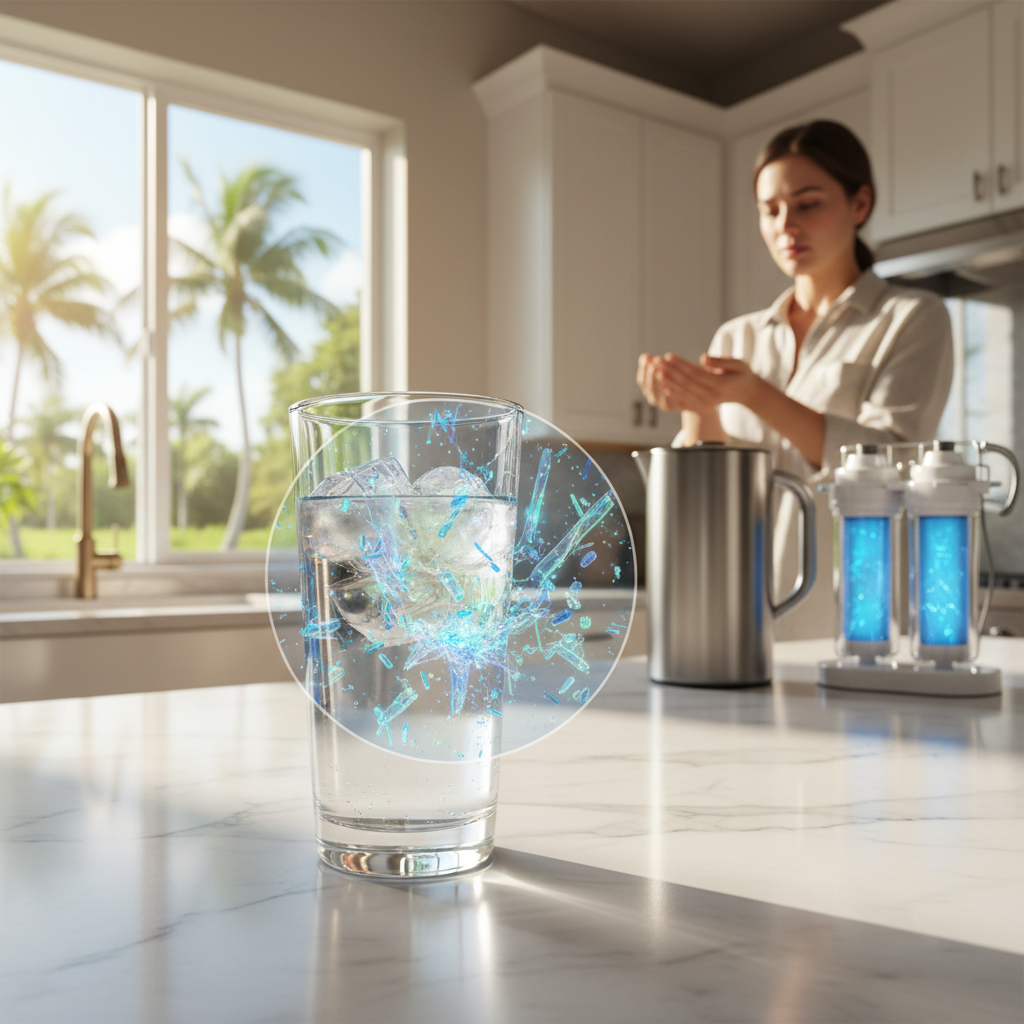
Microplastics in Florida drinking water have moved from a theoretical concern to a documented reality for millions of residents across the Sunshine State. As urban development expands and the reliance on plastic products persists, these microscopic polymer fragments—measuring less than five millimeters—are increasingly detected in both municipal tap water and private wells. Understanding the specific vulnerabilities of our local hydrology, from the sandy soils of the Panhandle to the porous limestone of the Biscayne Aquifer, is the first step in ensuring your family consumes truly clean water.
Key takeaways for Florida homeowners
- Microplastics are prevalent in Florida's surface and groundwater due to stormwater runoff and high plastic consumption.
- Standard municipal water treatment is not specifically designed to capture sub-micron nanoplastics.
- The porous nature of Florida's limestone aquifers allows contaminants to migrate more easily into the water table.
- In-home filtration, specifically Reverse Osmosis (RO), remains the most effective defense against these particles.
The state of plastic pollution in Florida aquifers
Florida's unique geology plays a significant role in how microplastics in Florida drinking water proliferate. Unlike states with dense clay layers that act as natural filters, much of Florida sits atop karst limestone. This porous structure, particularly in the Floridan and Biscayne aquifers, allows rainwater to carry surface pollutants—including microplastics from tire wear and synthetic clothing fibers—directly into our primary sources of drinking water. According to the Florida Department of Environmental Protection (DEP), the proximity of the water table to the surface in coastal regions further increases the risk of contamination from urban runoff.
Health implications of ingesting microplastics
While research is ongoing, recent studies highlighted by the National Institute of Environmental Health Sciences (NIEHS) in June 2026 suggest that microplastics and even smaller nanoplastics can cross biological barriers. These particles may act as vectors for endocrine-disrupting chemicals (EDCs) and heavy metals. For Florida residents, who often experience higher levels of UV exposure which breaks down plastics faster, the concentration of these additives can be particularly concerning. The World Health Organization (WHO) and the CDC continue to monitor the long-term inflammatory responses associated with chronic plastic ingestion.
Bottled water vs tap water in Florida
Many homeowners turn to bottled water, assuming it is a safer alternative to microplastics in Florida drinking water. However, data frequently suggests the opposite. Research published in the Proceedings of the National Academy of Sciences has indicated that bottled water can contain up to 100 times more plastic particles than tap water, largely due to the leaching from the plastic bottle itself and the manufacturing process. For those seeking long-term health, treating the water at the source in the home is more reliable than purchasing single-use plastics.
| Water Source | Typical Microplastic Count | Primary Particle Type |
|---|---|---|
| Florida Tap Water | Low to Moderate | Fibers from laundry, tire wear | Bottled Water | High to Very High | PET fragments from the bottle | Filtered Tap (RO) | Negligible | N/A |
How to effectively remove microplastics from your home
If you are concerned about your exposure, standard carbon pitchers may not be sufficient to capture the smallest fragments. To ensure your home is protected, follow this checklist for water safety:
- Professional Water Testing: Start by identifying the specific contaminants in your local supply. You should book a water test to get a baseline reading of your water quality.
- Reverse Osmosis Systems: Install a multi-stage RO system. These membranes have pores small enough to block particles as small as 0.0001 microns, effectively removing microplastics and nanoplastics.
- Point-of-Entry Filtration: Consider a whole-home system to prevent microplastic exposure in showers and during food preparation.
- Regular Maintenance: Change filters according to manufacturer guidelines to prevent breakthrough contamination.
What to do next
The presence of microplastics in Florida drinking water is a complex issue, but it is manageable with the right technology. Protecting your household starts with accurate information. We recommend all Florida homeowners take a proactive approach to their clean living journey. You can start today by completing our free Water Health Assessment to receive a personalized analysis of your local water risks and potential solutions tailored to your home's needs.
Frequently asked questions
Are microplastics in Florida drinking water regulated by the EPA?
As of 2026, there are no federal EPA mandates specifically setting Maximum Contaminant Levels (MCLs) for microplastics in public drinking water. Most municipal utilities monitor for standard chemicals and bacteria but do not yet have requirements for plastic particle filtration.
Can I taste microplastics in my water?
No, microplastics and nanoplastics are microscopic and have no taste, color, or odor. Their presence can only be confirmed through laboratory testing or sophisticated detection methods.
Which Florida cities have the highest microplastic levels?
High-density coastal areas such as Miami, Fort Lauderdale, and Tampa often show higher concentrations in surface water due to concentrated urban runoff and high volumes of wastewater discharge, though aquifer-sourced water in rural areas is not immune.
Does boiling water remove microplastics?
Boiling water does not remove microplastics; in fact, it may slightly increase their concentration by evaporating some of the liquid. While some studies suggest calcium carbonate in hard water can trap particles when boiled, it is not a reliable purification method compared to filtration.