
Microplastics in Florida Drinking Water: Risks and Solutions
Discover how microplastics in Florida drinking water affect your health. Learn to identify contamination sources in the Biscayne Aquifer and choose the best filtration systems.
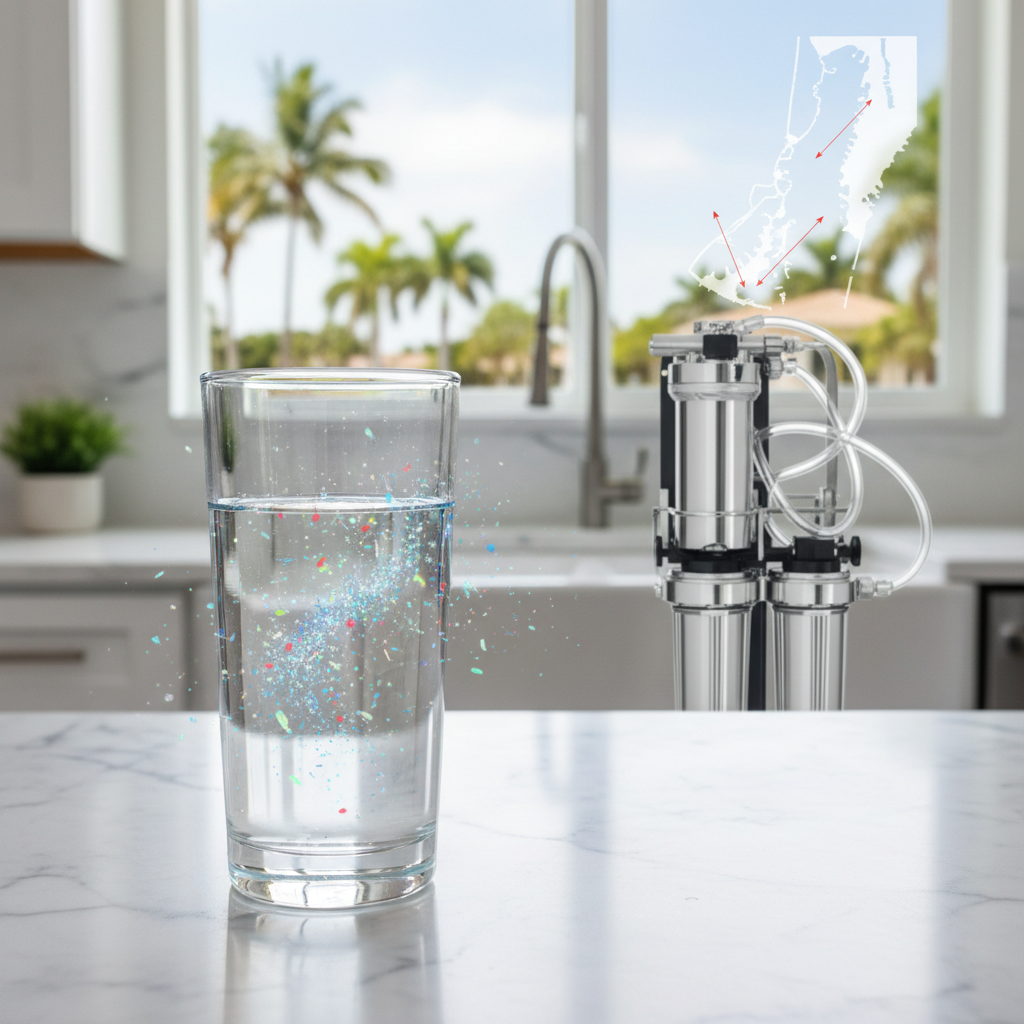
Understanding the prevalence of microplastics in Florida drinking water is essential for homeowners prioritizing long-term health and clean living. As urban development expands across the Sunshine State, the intersection of plastic waste and our unique hydrogeology has created a complex challenge for water safety. These microscopic plastic fragments, often smaller than five millimeters, have been detected in both municipal tap water and private wells drawing from the Floridan and Biscayne aquifers. This guide explores the sources of contamination, potential health risks, and the most effective residential filtration strategies to ensure your family's water remains pure.
Key takeaways
- Florida's porous limestone geography allows microplastics to infiltrate groundwater aquifers more easily than in other regions.
- Recent studies indicate that bottled water often contains significantly more micro- and nanoplastics than filtered tap water.
- Advanced filtration, specifically reverse osmosis and sub-micron carbon blocks, is the most reliable method for removing these particles at home.
- Regularly testing your water is the first step in identifying specific contamination levels in your local municipality.
The prevalence of plastic in Florida's aquifers
Florida's water supply depends heavily on groundwater. The state's geology is characterized by karst topography—a landscape of porous limestone that acts like a sponge. While this allows for efficient water storage, it also means that surface pollutants, including degraded plastic debris from landfills and stormwater runoff, can migrate into the drinking supply with minimal natural filtration. In South Florida, the Biscayne Aquifer is particularly vulnerable due to its proximity to the surface and high permeability.
Research synthesized by the National Oceanic and Atmospheric Administration (NOAA) highlights that microplastics are now omnipresent in aquatic environments. In Florida, the heavy use of single-use plastics and the state's extensive coastline contribute to a cycle where plastic breaks down into secondary microplastics. These particles eventually reach the wastewater stream and, in some cases, the treated water delivered to homes.
Health implications of microplastic ingestion
While the long-term effects on humans are still being studied, the World Health Organization (WHO) and various peer-reviewed studies have raised concerns regarding the chemical additives found in plastics. Bisphenol A (BPA) and phthalates, known endocrine disruptors, can leach into water from microplastic particles. Once ingested, these particles may trigger inflammatory responses or oxidative stress within the body.
A study published by the Proceedings of the National Academy of Sciences (PNAS) used advanced imaging to find that bottled water can contain hundreds of thousands of nanoplastics per liter. These particles are small enough to cross the blood-brain barrier and enter the placenta, posing unique risks to vulnerable populations. For Florida homeowners focused on longevity, reducing exposure in the primary hydration source is a critical health intervention. You can begin by taking a free Water Health Assessment to evaluate your home's risks.
Bottled water vs filtered tap water
Many consumers turn to bottled water as a perceived safer alternative to tap water. However, recent findings suggest the opposite may be true regarding microplastics. The process of bottling, the friction of opening plastic caps, and the exposure to Florida's heat during transport can cause the plastic containers to shed particles directly into the water. In contrast, tap water treated with a point-of-use filtration system often shows remarkably lower plastic counts.
The Florida Department of Environmental Protection (DEP) monitors primary contaminants, but microplastics currently lack a federal maximum contaminant level. This regulatory gap leaves the responsibility of final purification to the homeowner. Moving away from bottled water not only reduces plastic ingestion but also prevents further environmental degradation of Florida's ecosystems.
Effective filtration methods for microplastics
Not all water filters are designed to capture microplastics. Standard pitcher filters may improve taste but often lack the mechanical capacity to strain out sub-micron particles. For comprehensive protection, homeowners should look for systems validated by NSF/ANSI standards for particulate reduction.
| Filtration Type | Effectiveness | Mechanism |
|---|---|---|
| Standard Carbon Pitcher | Low | Adsorption of chemicals; limited physical filtration. |
| 0.5 Micron Carbon Block | Moderate | Mechanically traps particles larger than 0.5 microns. |
| Reverse Osmosis (RO) | High | Uses a semi-permeable membrane to block particles at the molecular level. |
| Ultrafiltration (UF) | High | Effective for large macromolecules and microplastics. |
Reverse osmosis remains the gold standard for microplastic removal. By forcing water through a membrane with pores as small as 0.0001 microns, it effectively eliminates nearly all plastic fragments, including the increasingly concerning nanoplastics. To find the right system for your specific water chemistry, it is advisable to book a water test with a qualified specialist.
The environmental feedback loop in Florida
The issue of microplastics in Florida drinking water is compounded by the state's climate. High UV index levels accelerate the degradation of plastic litter into secondary microplastics. During heavy rain events, which are common in tropical and subtropical Florida, these particles are washed into the sea and the groundwater systems. The Florida Fish and Wildlife Conservation Commission (FWC) has noted microplastic presence in various marine species, indicating a widespread contamination of the state's watershed that ultimately impacts the human food and water chain.
What to do next
Protecting your home from microplastic contamination requires a proactive approach to water management. Because microplastics are invisible and odorless, you cannot rely on your senses to detect them. Taking charge of your home's water quality is a foundational step in a clean living lifestyle.
- Evaluate your current water source by checking the latest Annual Water Quality Report (Consumer Confidence Report) from your local Florida utility.
- Reduce the use of single-use plastic bottles in your home to prevent localized shedding and environmental waste.
- Perform a free Water Health Assessment to identify potential vulnerabilities in your home's plumbing and filtration.
- Install a high-quality point-of-use filtration system, such as reverse osmosis, to serve as a final barrier against micro- and nanoplastics.
- Consult with a professional to book a water test if you rely on a private well, as these are not monitored by municipal agencies.
Frequently asked questions
Can standard carbon filters remove microplastics?
Standard carbon block filters can remove larger microplastics if they have a pore size of 1 micron or less. However, they may not catch nanoplastics. Reverse osmosis systems are generally considered the most effective for removing the smallest plastic particles.
How do microplastics get into Florida's groundwater?
Microplastics enter Florida's groundwater through bottled water runoff, landfill leachate, and treated wastewater. In karst regions like Florida, the porous limestone allows surface contaminants to migrate quickly into aquifers used for drinking water.
Is bottled water safer than tap water for microplastics?
Research frequently shows that bottled water contains higher concentrations of microplastics than tap water. This is often due to the plastic bottle itself shedding particles into the liquid, especially when exposed to heat during transport or storage.
Are microplastic levels regulated by the EPA?
As of 2026, the EPA has not established a Maximum Contaminant Level (MCL) for microplastics in drinking water. However, state-level monitoring and federal research initiatives are currently evaluating the long-term health impacts to inform future regulations.