
Microplastics in Florida Drinking Water: 2026 Homeowner Guide
Discover how microplastics affect Florida drinking water and the Biscayne Aquifer. Learn how to protect your home with high-performance filtration and professional testing.
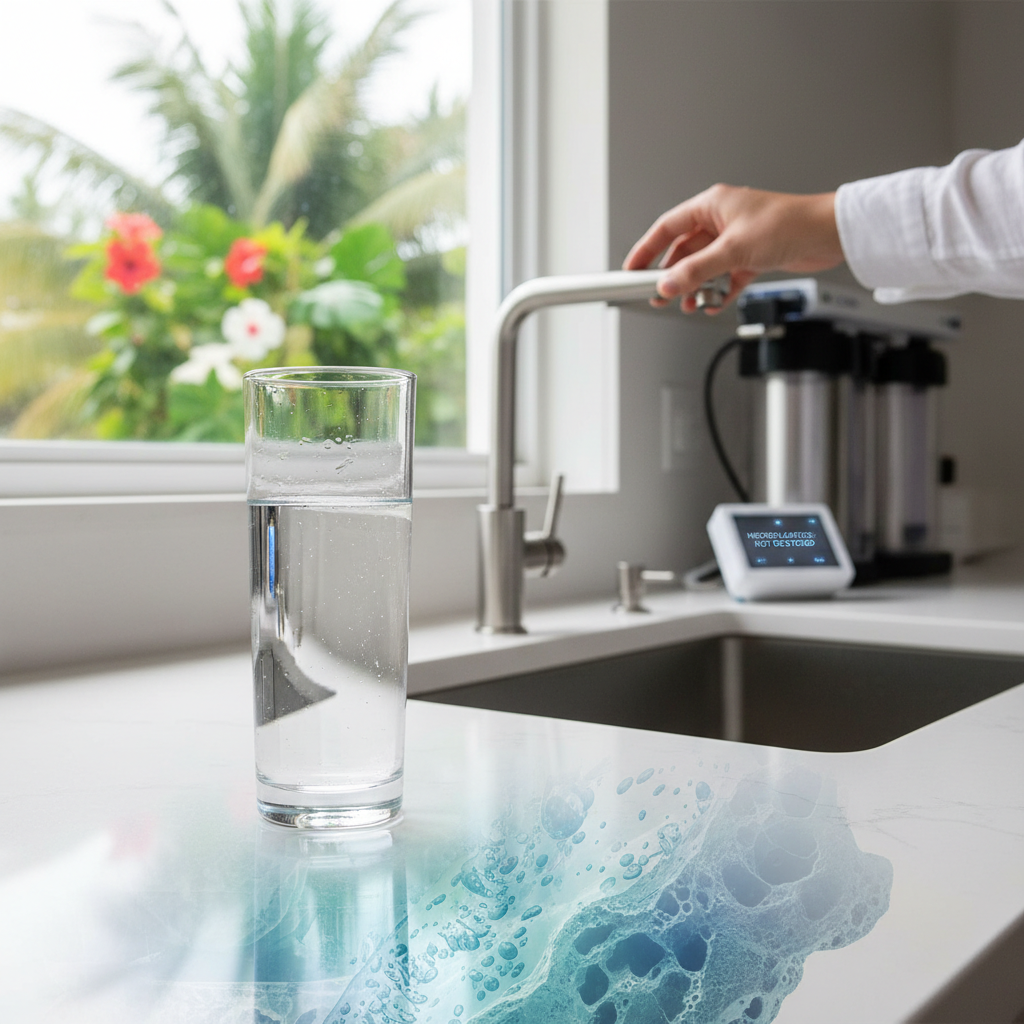
Microplastics in Florida drinking water have become a significant concern for homeowners as recent studies highlight the persistence of synthetic particles in our state's unique hydrogeological systems. From the porous limestone of the Biscayne Aquifer to the sprawling Surficial Aquifer system, plastic fragments smaller than five millimeters are bypassing traditional municipal treatment processes. Understanding how these contaminants enter your home is the first step toward securing a cleaner, healthier living environment for your family.
Key takeaways
- Microplastics are widely detected in Florida surface waters and groundwater due to stormwater runoff and plastic degradation.
- Standard municipal water treatment is often not designed to capture nanoplastics or the smallest microplastic fibers.
- The Biscayne Aquifer is particularly vulnerable to surface contaminants due to its highly permeable limestone structure.
- Point-of-use filtration, specifically Reverse Osmosis (RO), is the most effective residential defense against these particles.
The state of plastic pollution in Florida water
Florida's water supply is inextricably linked to its surface environment. Recent environmental surveys near South Florida's coastal regions have prompted organizations like the Guy Harvey Foundation to increase awareness regarding marine life and water health. As of 2026, researchers have noted that Florida's sandy coastlines and inland waterways serve as catchments for plastic debris. During events such as sand sculpture contests or coastal festivals, community efforts now frequently include sifting for microplastics, reflecting a growing public realization that these particles are ubiquitous.
According to the Florida Department of Environmental Protection (DEP), the state's reliance on groundwater means that what happens on the surface eventually impacts the tap. Rainfall washes synthetic fibers from clothing, tire wear particles, and degraded single-use plastics into the soil. In regions with high water tables, these contaminants can migrate into the aquifer faster than in states with denser, less permeable soil structures.
How microplastics enter the Biscayne Aquifer
The Biscayne Aquifer provides water for millions of residents in Miami-Dade, Broward, and Palm Beach counties. Because this aquifer is composed of highly porous limestone and sits very close to the surface, it is highly susceptible to saltwater intrusion and surface-level pollutants. When microplastics enter this system, they do not simply disappear; they can act as vectors for other chemicals, including PFAS and heavy metals, which adhere to the plastic surface.
While the EPA has begun monitoring smaller particles under the Unregulated Contaminant Monitoring Rule (UCMR), many homeowners find that local utility reports do not yet provide specific counts for microplastic concentrations. This gap in data makes it essential for residents to take proactive measures. You can start by completing a free Water Health Assessment to understand your home's specific risk profile.
Health implications of ingesting nanoplastics
Research published in peer-reviewed journals such as Environmental Science & Technology suggests that humans may ingest tens of thousands of plastic particles annually through drinking water alone. Once inside the body, nanoplastics—particles smaller than one micrometer—are small enough to cross biological membranes, potentially entering the bloodstream or lymphatic system. The long-term health effects are still being studied by the CDC and global health authorities, but the precautionary principle suggests that minimizing exposure is the safest course of action for longevity-focused homeowners.
Comparing filtration methods for plastic removal
Not all water filters are created equal when it comes to microscopic particles. While a basic pitcher filter might improve taste by removing chlorine, it often lacks the pore size necessary to trap the smallest fibers. The following table outlines the efficacy of common home filtration types against microplastics.
| Filter Type | Microplastic Removal | Mechanism |
|---|---|---|
| Standard Carbon Pitcher | Low to Moderate | Adsorption (limited by pore size) |
| Sediment Filters (5 Micron) | Moderate | Mechanical straining |
| Ultrafiltration (UF) | High | 0.01-micron membrane barrier |
| Reverse Osmosis (RO) | Very High | Semi-permeable membrane (0.0001 micron) |
Steps to protect your Florida home
Ensuring your water is free from microplastics requires a multi-layered approach to home water management. Residents in high-traffic coastal areas or near industrial centers should be particularly vigilant.
- Professional Testing: Standard DIY kits rarely detect microplastics. You should book a water test with a laboratory capable of identifying particulate matter at the sub-micron level.
- Install Reverse Osmosis: For the highest level of purity, an undersink or whole-home RO system provides a physical barrier that most plastics cannot penetrate.
- Maintain Systems: Filters must be changed according to manufacturer specifications to prevent "breakthrough," where trapped particles are forced through a saturated filter.
- Reduce Plastic Use: Minimizing the use of plastic bottles and containers in the kitchen reduces the secondary introduction of microplastics into your food and drink.
What to do next
Protecting your family from microplastics in Florida drinking water is an achievable goal with the right technology and information. Start by assessing your current water quality. If you use a basic pitcher or refrigerator filter, consider upgrading to a system validated for cyst and lead removal, as these typically have tighter membranes that also capture microplastics. For a comprehensive analysis tailored to Florida's unique water challenges, take our free Water Health Assessment today or explore our related guides to learn more about clean living in the Sunshine State.
Frequently asked questions
Are microplastics regulated in Florida tap water?
Currently, there are no federal or state-mandated Maximum Contaminant Levels (MCLs) specifically for microplastics in drinking water. However, the EPA is actively researching the prevalence of these particles to determine if future regulation is necessary under the Safe Drinking Water Act.
Can I see microplastics in my glass of water?
By definition, microplastics are five millimeters or smaller, and nanoplastics are completely invisible to the naked eye. Most particles found in tap water are secondary microplastics—tiny fibers shed from synthetic materials—that require a microscope to detect.
Does boiling water remove microplastics?
No, boiling water does not remove microplastics. In fact, boiling can concentrate the particles by evaporating some of the water. Some studies suggest that boiling very hard water can trap microplastics inside calcium carbonate precipitates, but this is not a reliable or recommended removal method.
Will a whole-home water softener remove plastics?
A standard ion-exchange water softener is designed to remove minerals like calcium and magnesium that cause hardness. It is not an effective solution for microplastic removal. For plastic filtration, you need a physical barrier like a sub-micron sediment filter or a reverse osmosis membrane.