
Lead Contamination in Florida Municipal Water: Homeowner Risks
Is your tap water safe? Learn about lead contamination in Florida municipal water, aging infrastructure risks, and how to protect your home’s drinking water today.
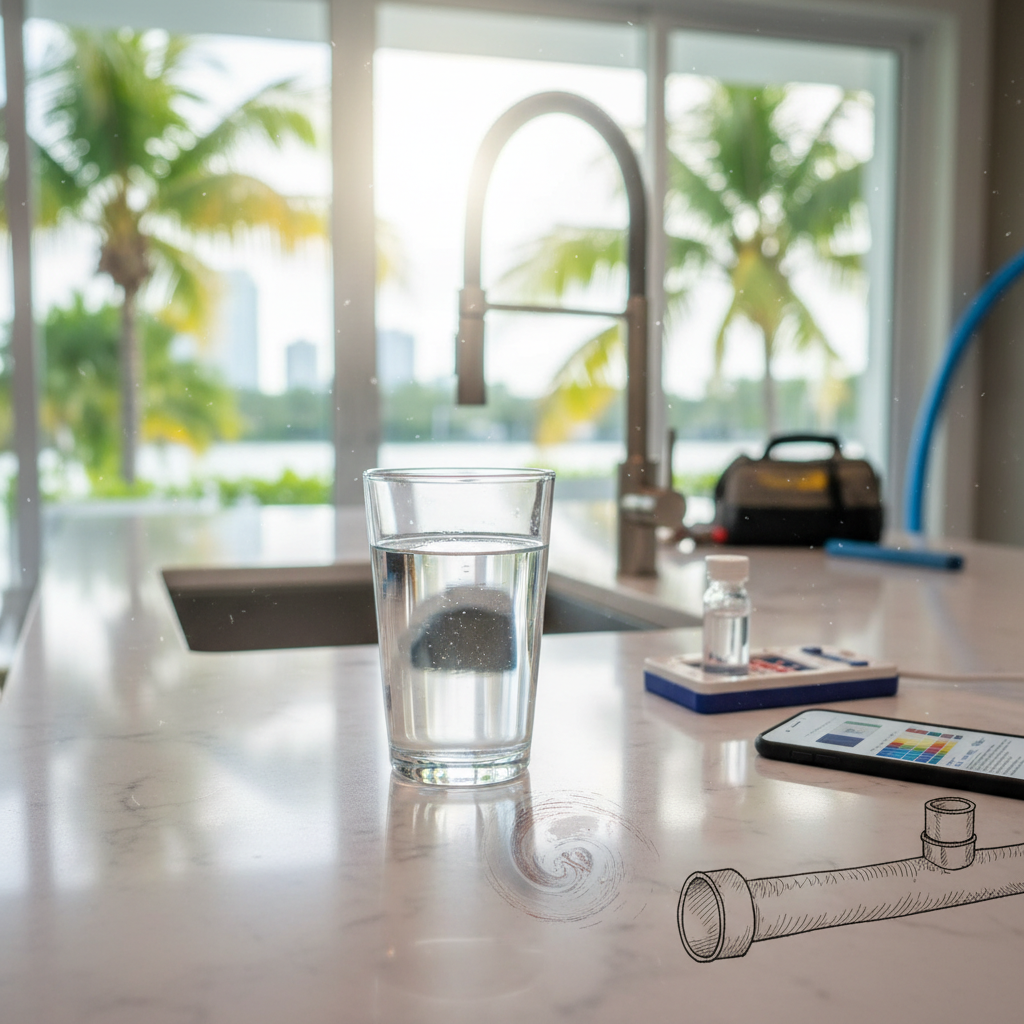
Lead contamination in Florida municipal water remains a critical concern for homeowners despite modern treatment standards. While Florida utilities generally meet federal guidelines at the source, the path from the treatment plant to your kitchen faucet is often lined with aging infrastructure. As of 2026, many Florida communities are grappling with the reality of legacy lead service lines and the corrosive nature of local groundwater, which can leach heavy metals from household plumbing into the water you drink every day.
Key takeaways
- Florida’s aging infrastructure and corrosive groundwater increase the risk of lead leaching into residential taps.
- Municipal water reports reflect quality at the plant, not necessarily at your specific kitchen faucet.
- Recent storm surges and flooding in areas like Plantation and Fort Myers can exacerbate water quality fluctuations.
- Point-of-entry filtration is the most reliable method for ensuring lead-free water for the entire household.
The hidden path of lead contamination in Florida
The primary source of lead contamination in Florida municipal water is rarely the municipality itself. Instead, lead enters the stream through the "last mile" of delivery. This includes lead service lines, lead-based solder used in copper piping, and older brass fixtures. According to the Environmental Protection Agency (EPA), even "lead-free" brass fixtures manufactured before 2014 could contain up to 8% lead. In Florida’s humid, salt-heavy environment, the rate of corrosion for these materials can be higher than in drier inland states.
Geology also plays a role. In South Florida, the Biscayne aquifer provides highly productive but naturally soft water. Utilities must carefully manage the pH levels of this water to prevent it from becoming aggressive. If the chemical balance shifts, the water can strip lead from older plumbing components within minutes of contact. This is particularly problematic in historic districts in cities like Miami, St. Petersburg, and West Palm Beach, where homes built before the 1986 lead ban are still prevalent.
Infrastructure challenges and the 2026 outlook
As of June 2024, cities across the state, such as Plantation, have highlighted how increased rainfall and stronger storms are taxing local infrastructure. While the focus is often on stormwater and flooding, these environmental pressures also strain the integrity of potable water systems. When water tables rise or coastal saltwater intrusion occurs, the shifting groundwater chemistry can alter the effectiveness of corrosion inhibitors added by municipal utilities.
Furthermore, Florida is currently undergoing a massive lead service line inventory as mandated by the EPA's Lead and Copper Rule Improvements (LCRI). Homeowners should be aware that while utilities are working to identify and replace public lead lines, the portion of the service line on private property remains the responsibility of the homeowner. This leaves a significant gap in protection for many residents who may be unaware that their specific connection is a source of lead contamination in Florida municipal water.
Health impacts and legal limits
There is no known safe level of lead exposure, a fact emphasized by both the CDC and the World Health Organization. Lead is a cumulative toxicant that affects multiple body systems, including the central nervous system and kidneys. In children, even low levels of exposure are linked to permanent developmental delays and behavioral issues.
| Exposure Level | Target Population | Common Symptoms/Risks |
|---|---|---|
| Low-Level | Children & Infants | Lowered IQ, hyperactivity, hearing loss, anemia. |
| Moderate-Level | Adults | Hypertension, joint pain, memory loss, kidney dysfunction. |
| Chronic-High | All Ages | Severe neurological damage, reproductive issues, organ failure. |
While the EPA's current "action level" for lead is 15 parts per billion (ppb), many health advocates argue this limit is based on what is technologically feasible for a city to treat, rather than what is biologically safe for a human. For those pursuing a lifestyle focused on longevity and clean living, any detectable lead is considered a failure of the water system.
How to identify lead risks in your home
Determining if you have lead contamination in Florida municipal water requires a proactive approach. You cannot see, taste, or smell lead in water. The first step is to identify the age of your home and the materials used in your plumbing. Homes built before 1986 are at the highest risk. Check your service line—the pipe that enters your home from the street. If it is dull gray and can be easily scratched with a coin to reveal a shiny, silver color, it is likely lead.
However, even newer homes are not immune. Galvanized steel pipes that have been connected to lead lines in the past can trap lead particles and release them into the water over time. To get an accurate picture of your water quality, you should book a water test with a certified laboratory that can detect heavy metals at the parts-per-billion level.
Protection strategies for Florida homeowners
Relying solely on municipal reports—often called Consumer Confidence Reports—is insufficient because those tests are conducted at scheduled intervals and specific sampling sites that may not mirror your home's conditions. For absolute certainty, homeowners should consider a multi-stage filtration approach. While some pitcher filters are certified for lead removal, they only treat a small volume of water and require frequent, expensive cartridge changes.
A point-of-entry (POE) system, such as a whole-home carbon or reverse osmosis system, provides a comprehensive shield. These systems ensure that every tap, showerhead, and appliance is supplied with purified water. This is especially important for Florida families who use filtered water for cooking or washing organic produce, where lead can easily be absorbed. Before investing in hardware, taking a free Water Health Assessment can help you determine the specific contaminants present in your local supply.
What to do next
Protecting your home from lead contamination in Florida municipal water requires a combination of verification and action. Start by checking the local utility's lead service line map if available in your county. If you use a private well, as many do in Indian River County or rural areas of the state, be aware that you are solely responsible for testing for contaminants like lead and PFAS.
- Inspect your main water shut-off valve and visible piping for lead or galvanized steel.
- Flush your taps for 1-2 minutes every morning if the water has been sitting in the pipes overnight.
- Only use cold water for drinking and cooking, as hot water leaches lead more effectively.
- Obtain a professional water analysis to measure exact lead concentrations.
- Consult with a water quality specialist to install a filtration system tailored to Florida's unique water chemistry.
Frequently asked questions
How does lead get into Florida municipal water if it was banned in 1986?
While the installation of lead pipes was banned in 1986, many existing pipes and lead-based solders remained in the ground and in the walls of homes. Over time, these materials corrode and release lead into the drinking water, especially if the water chemistry fluctuates or if the pipes are disturbed by construction.
Can I just boil my water to remove lead?
No, boiling water does not remove lead. In fact, boiling water actually concentrates lead levels because some of the water evaporates while the lead remains behind. Filtering through a certified lead-removal system is the only effective way to eliminate lead from your tap water.
Are Florida water utilities required to tell me if I have lead pipes?
Under the EPA’s 2021 Lead and Copper Rule Revisions, utilities must create and maintain a public inventory of lead service lines. By 2024–2026, most Florida utilities are required to notify customers if they are served by known or suspected lead lines, but this does not always cover internal household plumbing or solder.
Does the age of my home in Florida determine my lead risk?
Generally, yes. Homes built before 1986 are at higher risk because lead was commonly used in pipes and solder. However, homes built up until 2014 may still have brass fixtures that contain small amounts of lead. High-quality water testing is recommended regardless of your home's age for total peace of mind.