
Florida EPA Water Contaminant Report: Is Your Tap Water Safe?
Is your Florida tap water safe? Our 2026 Florida EPA water contaminant report analysis reveals hidden risks from lead to saltwater intrusion. Protect your home today.
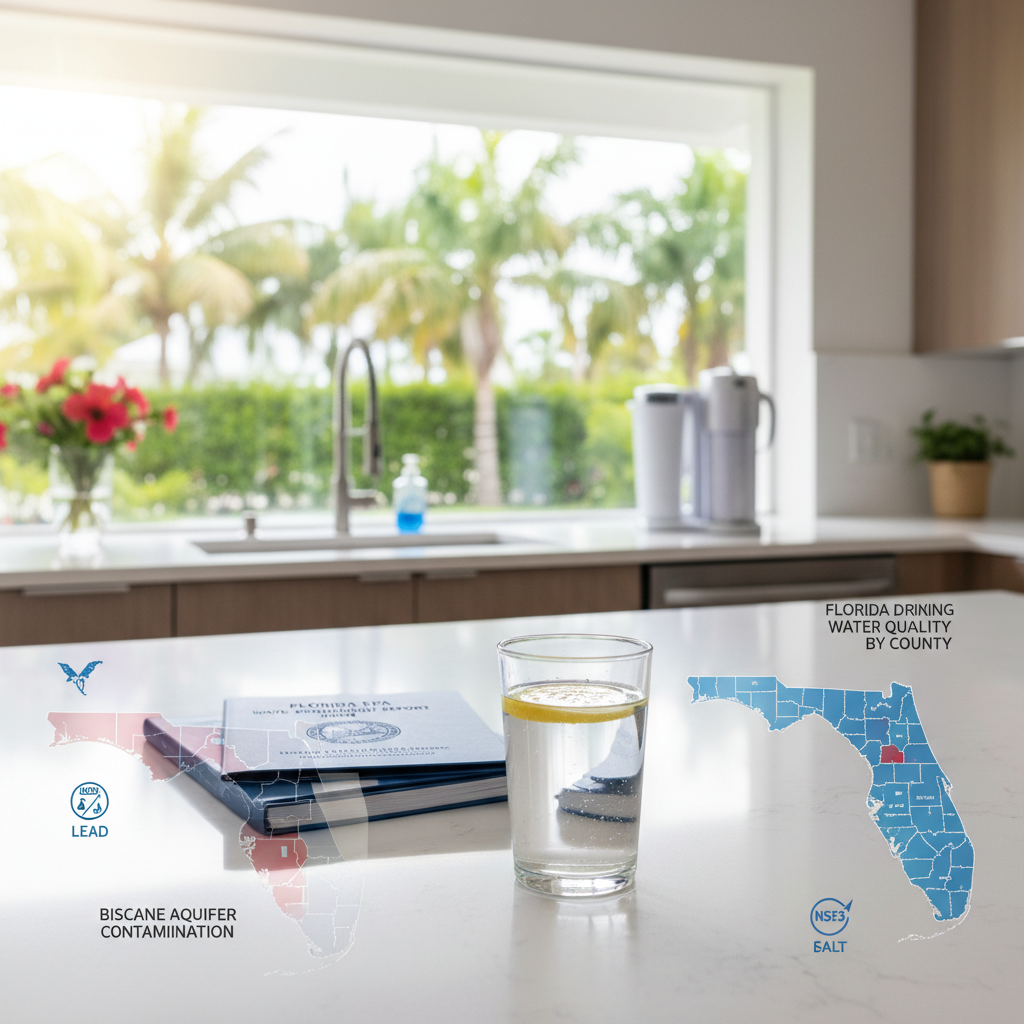
The latest Florida EPA water contaminant report serves as a critical health snapshot for millions of residents across the Sunshine State. While municipal utilities often report meeting federal standards, the journey of water from the treatment plant to your kitchen sink can introduce hidden hazards including lead, bacteria, and chemical byproducts. Understanding these local reports is the first step in ensuring your family consumes only the cleanest possible water for long-term health and longevity.
Key takeaways for Florida homeowners
- Most Florida water quality issues occur between the utility main and your home's faucets, particularly in older neighborhoods.
- Coastal regions, specifically those drawing from the Biscayne aquifer, face increasing risks from saltwater intrusion and localized bacterial spikes.
- The EPA and CDC emphasize that lead levels can vary significantly even between neighboring houses due to legacy plumbing.
- Certified home filtration is often the only way to guarantee the removal of contaminants that municipal plants are not required to filter completely.
Understanding the 2026 Florida water landscape
As of June 20, 2026, Florida's unique geology continues to present specific challenges for water safety. The state relies heavily on groundwater, primarily from the Floridan and Biscayne aquifers. Because these sources are susceptible to surface runoff and rising sea levels, the Florida Department of Environmental Protection (FDEP) maintains rigorous monitoring. However, a "passing" score on a municipal report does not always account for the specific contaminants entering your home through aging service lines.
According to recent environmental monitoring data, coastal areas have seen a rise in enterococci bacteria during peak summer months, similar to patterns observed in the federal BEACH Act monitoring programs (EPA, 2026). These bacteria, often found in sewage pollution, can lead to infections or skin rashes if not properly addressed at the point of use. To verify the safety of your specific residence, we recommend you book a water test with a professional.
The hidden threat of lead in Florida plumbing
Lead remains one of the most serious concerns for Florida homeowners, especially those in homes built before the late 1980s. Lead typically enters the water supply through aging lead service lines, brass fixtures, and lead-based solder. The EPA and CDC have consistently stated that no level of lead is safe for children, making it imperative for homeowners to look beyond the general city report.
Research published in 2026 highlights that two houses on the same street can have vastly different lead concentrations at the tap. While a city like Fairfield might report zero violations for primary contaminants (Daily Republic, 2025), the internal plumbing of a private residence remains the responsibility of the owner. Homeowners should prioritize filters with NSF/ANSI 53 certification, which is the industry gold standard for lead reduction.
Comparing common Florida water contaminants
The following table outlines the most frequent contaminants identified in Florida's regional water supplies and their primary sources according to FDEP and EPA data.
| Contaminant | Primary Source in Florida | Health Risk |
|---|---|---|
| Lead | Aging pipes, brass fixtures, lead solder | Neurological damage, developmental delays | Enterococci | Sewage runoff, coastal seawater intrusion | Gastrointestinal illness, skin rashes | PFAS | Industrial runoff, firefighting foams | Hormonal disruption, increased cancer risk | Total Trihalomethanes | Byproduct of chlorine disinfection | Long-term liver and kidney issues |
Actionable checklist for water safety
- Identify your service line: Check your home's historical records or visit your local utility website to see if your property is served by lead or galvanized steel pipes.
- Review your CCR: Every year, your utility provider issues a Consumer Confidence Report (CCR). Read it carefully for any "Action Level" exceedances.
- Request a targeted test: General reports do not reflect the water at your tap. You should book a water test if you notice any metallic taste, cloudiness, or if you live in a home built before 1986.
- Verify certifications: When shopping for filters, look for NSF/ANSI 53 or 58 labels. Many standard pitchers only improve taste (NSF 42) without removing heavy metals.
- Professional assessment: Complete a free Water Health Assessment to get a customized plan for your specific Florida ZIP code.
The impact of Florida climate on water quality
Florida’s climate plays a significant role in the findings of any Florida EPA water contaminant report. High heat and humidity accelerate the growth of certain microorganisms in standing water, while heavy seasonal rains increase pesticide and fertilizer runoff into the aquifer. Furthermore, saltwater intrusion caused by rising sea levels in coastal counties can increase the salinity and mineral content of well water, often requiring specialized reverse osmosis systems to maintain potability.
Research suggests that as the Biscayne aquifer faces increased pressure from saltwater, the chemical balance of treated water can shift, potentially becoming more corrosive to residential lead pipes.
What to do next
Staying informed is the first step, but taking action ensures your home remains a sanctuary of health. Do not wait for a municipal advisory to protect your family from invisible contaminants. Start by reviewing related guides on whole-home filtration and then take the next concrete step by using our water assessment tool to identify the specific risks in your Florida county. Secure your water quality today to support long-term wellness for years to come.
Frequently asked questions
How do I find my specific Florida EPA water contaminant report?
You can find your local report by visiting the EPA’s Safe Drinking Water Information System (SDWIS) or your local municipal utility's website. These reports, often called Consumer Confidence Reports (CCR), are legally required to be published by July 1st each year.
Does a passing grade from the city mean my water is lead-free?
Not necessarily. City reports measure water at the treatment plant or specific sampling points, but they do not account for lead leached from the pipes in your street or the plumbing inside your home. Independent testing is the only way to know the lead level at your kitchen faucet.
What is the best water filter for Florida tap water?
The best filter depends on your local contaminants, but generally, a multi-stage system with NSF/ANSI 53 and 58 certifications is recommended for Florida homes. These certifications ensure the removal of lead, PFAS, and common Florida bacteria.